

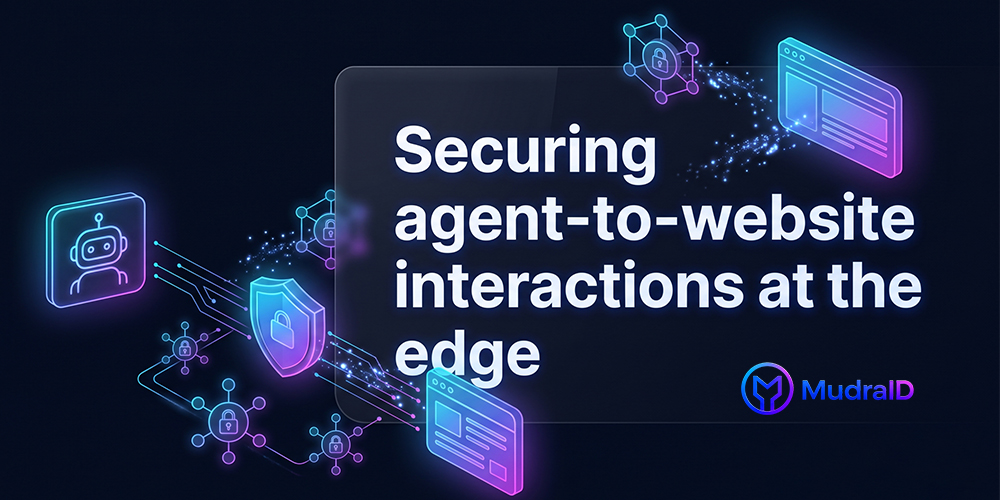
Once agents have a verifiable identity, the engineering question becomes practical: where do you actually check it? The best answer for most teams is the same place that already handles incoming traffic — the edge. Verifying an agent at the CDN edge or API gateway means unauthorized requests never reach your origin, and trusted ones pass with negligible overhead.
The good news is that this rarely requires re-architecting anything. The edge is already there; you are adding a verification step at a boundary you already control.
How edge verification works
A verifiable agent attaches a signed credential to its request — proof of who it is and, via delegated authority, what it is allowed to do. The verifying layer does three quick things on each request:
- Check the signature. Confirm the credential is authentic and unexpired.
- Check the agent. Confirm it is a known, non-revoked identity.
- Check the action. Confirm the request is within the agent’s granted scope.
All three are local, cryptographic operations — no guessing, no fingerprinting. A request that fails any check is rejected at the boundary; one that passes is forwarded to the origin already trusted.
Three places to verify
Static sites: verify at the CDN edge
A static marketing site or docs portal has no backend to speak of, but it is almost always served through a CDN with programmable edge functions. That edge function is the verification point: it inspects the agent’s credential on each request and decides whether to serve the content. You get agent verification on a fully static site without standing up a server.
APIs: validate at the endpoint
For an API, the request itself carries the credential, and the API validates it directly — ideally as middleware that runs before any business logic. Every endpoint inherits the same check, and a request that is not from a verified, authorized agent is turned away before it touches your data.
Gateways: keep control at the boundary
If you already run an API gateway or reverse proxy, it is the natural chokepoint. Centralizing verification at the gateway means one consistent policy for every service behind it, and one place to update when policy changes.
Verify once, at the edge, and your origin only ever sees traffic that has already proven who it is and what it may do.
Why the edge is the right layer
- Less origin load. Unauthorized requests are dropped before they cost you compute.
- Lower latency. A local signature check is far cheaper than a round trip to your backend.
- One policy. Verification lives at the boundary instead of being re-implemented in every service.
- No re-architecture. The app behind the edge stays as it is.
Where MudraID fits
MudraID provides the verifiable agent identities and the verification primitives that make this practical at the edge, the API, or the gateway. Agents present signed proof; your boundary checks it in real time and forwards only trusted traffic — so you can welcome legitimate automation without re-architecting your stack. See how it works.